2026.06.17
The Last Mile of Implementation
You've Got the Brand Guideline, Now What?
The real test only begins after the brand guideline is handed over
🤔 A question we get asked a lot
"Once the branding work is done, what will you actually give me?"
We usually answer: logo files, color swatches, typography specs, usage examples — in other words, the Brand Guideline.
The other person nods, seeming satisfied.
But honestly, every time we say that, there's a small nagging feeling underneath. Because the moment the guideline is handed off isn't really the finish line — it's actually when the brand starts getting truly tested.

📦 A brand doesn't just live in mockups
Everyone in design has this one bad habit —it's easy to fall in love with "the brand at its most perfect." A beautifully laid-out proposal deck, a clean product shot with plenty of negative space, a packaging mockup with just the right lighting. It looks great, it feels right.
But what's the reality?
Your product might end up on a dimly lit supermarket shelf crammed next to a pile of competitors. Your logo might get printed on a sticker some part-timer trimmed by hand and stuck crooked on the side of a box. Your brand colors might show up on different screens looking like a version you don't even recognize.
This isn't about the client doing anything wrong. This is just what it looks like when a brand actually gets used in the real world.
There's a line I once came across that really hit the mark: "We keep designing for perfection, but a brand is almost always experienced in the middle of chaos."
🧭So what are we actually thinking about when we build a guideline?
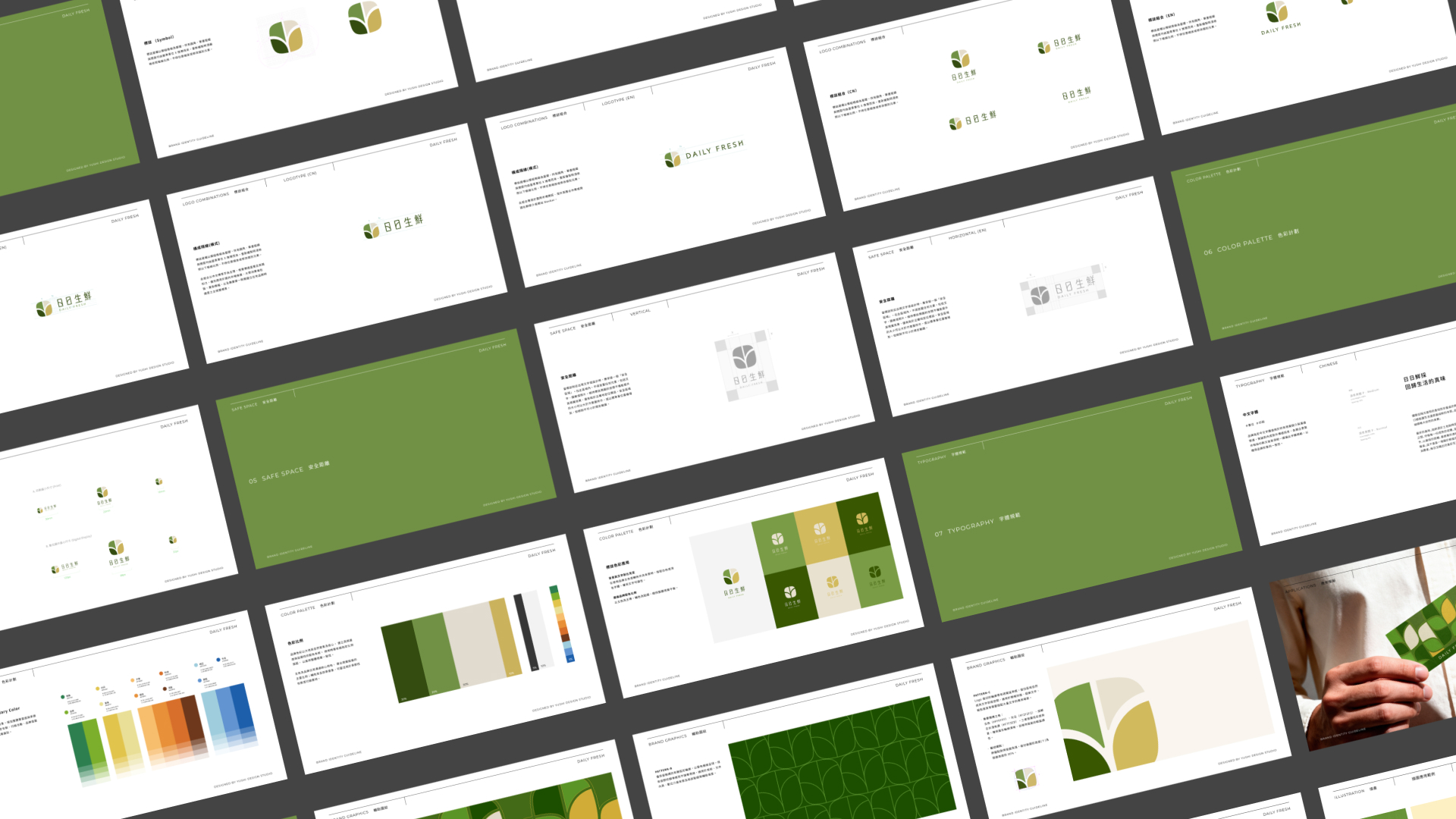
When we build a brand system, we make a point of asking ourselves a few fairly "realistic" questions:
If this logo gets shrunk down to business-card size, is it still legible?
If it can only be printed in black and white, does it still hold up? Does it still work on a dark background?
If this color palette gets shown on a different monitor or printed by a different vendor, does it still feel the way you wanted it to?
A color swatch isn't just a number — there needs to be an understanding of "what's the personality of this color" behind it, so that whoever uses it later can make consistent judgment calls.
If someone who isn't a designer picks up this document, will they actually understand it?
This is a question we used to deliberately avoid, because the honest answer was often "not necessarily." Now we try to write guidelines in a way that talks to people, instead of testing their reading comprehension.
🌪️Bringing a brand to life is harder than designing it
After the brand identity work is done, a lot of clients assume all that's left is to "just follow the guide."
But actually implementing a brand is full of variables. Who's executing it? Do they understand the brand's spirit? Does the outsourced vendor know the exact color values? How should a social media post be written to match the brand's tone of voice?
A guideline can provide a framework for these questions, but it can't predict everything for you.
Our approach: before delivery, we try to anticipate the "usage scenarios" that are likely to come up — listing out the most common real-world situations and discussing how to make the call in each one. And if new scenarios come up down the road, we discuss them with the client and update the guideline accordingly (yes! guidelines need maintenance too~).
🤝The guideline is a starting point, not a finish line
Brand identity design is a "laying the foundation" process. Once the foundation is solid, everything built on top of it has something to stand on — but it's completely normal for the foundation to be done while the house still isn't finished.
A brand needs time to be worked in and refined through real-world use. Some details only become clear once you actually run into the problem — that's when you know what the guideline needs to cover.
So if you've got a guideline in hand right now, but things feel a little "off" in various places once it's actually being used day to day — no need to panic. This is a process almost every brand goes through.
If it'd help, we can take a look together and figure out where it makes the most sense to start sorting things out.